Thursday, May 5, 2011

Exhibition season...

'Tis the season for exhibitions. My former classmates in NY are now putting up their thesis show
I'm excited for them, excited to see glimpses of where they've gone in the close-to-a-year since I've seen them, but also feeling really sad that I won't be there. This makes the abrupt leavetaking from NY feel more abrupt, and more unfinished...

On the upside, friends, teachers and former fellow-students are putting up shows left and right here in Israel, which I will be able to see--and which I know will well worth be seeing. Here is the list of some of the upcoming exhibitions I'm planning to hit next time I'm in Tel Aviv.

More on these once I've actually had a chance to see them.

Wednesday, April 27, 2011

Penuel--a history of a series

Now come the finishing touches of the exhibition, including the one I hate the most: the dreaded Artist Statement. One would think that it would be a breeze, considering how much I run on and on, whether in blog or in person. But there is something artificial about giving a single official "Statement" about works in which so many factors are involved, about works that you hope would not be constrained by words. It also seems to put a cap, a closing, while I see this series as on-going. This exhibition is a midpoint, a stop for thinking, considering, hopefully for feedback. It is not definitive.

When I look at the works, I see a history rather than a statement. The
different thoughts, experiences. processes that went into them, the different currents of thought that came together. The series began, actually, from a project for class:
the NYSS opened with the "transcription project," in which all the students were meant to make three small paintings based on pieces from the history of art. The topic for the pro
ject was Eros. I looked through countless images, from medieval art to Paul Gauguin, including Canova's sculpture of Cupid and Psyche. Something in the pattern of interlinking arches drew me, and I photocopied some images for consideration. In the end, I found the sculpture too sentimental for the Eros project, and based myself on Velásquez's Venus at the Mirror and Rodin's Paulo and Francesca instead. However, the Canova images remained in my studio, totalizing me.

Due to very unpleasant circumstances, I had to change classes and studios at the
beginning of the second semester. I found myself in a new space, feeling off balance and out of place. As an opening warm up, I decided to explore the Canova image in a charcoal drawing. To my surprise, small variations in the angles transformed a tender image of lovers into two figures locked in combat. This connected in my head to Rodin's drawings of wrestlers, which keep transforming into lovers--images that had also been in my studio since I had made my painting of Paulo and Francesca.
This led me to make more studies off the Canova image, trying to touch the abstract elements that allowed these two energies to co-exists.

These became Penuel I and II:


But I became more and more interested in the charcoal drawing, which had transformed for me from Cupid and Psyche into Jacob and the angle of Genesis 32. I emphasized the lines of struggle with lines, changed the angle of the head of the lower figure--now Jacob. The assailant became dark, ominous, the wing's transformed from soft feather to harsh line. The drawing connected to an earlier, abandoned series based on Gerard Manley Hopkin's Terrible Sonnets.

I began a new drawing, this time in ink, in which I combined my new image of struggle with the handwritten text of excerpts of Hopkin's "Carrion Comfort," where he uses the metaphor of Jacob's struggle with the angle to describe his own crisis of faith and battle with depression. This poem had reached out and grabbed me like a hand from the grave the first time I read it, and had remained on my mind ever since. On an intellectual level, I loved the seamless merging of the personal life with the biblical text, the archetypal framing of experience. On an emotional level, parts of the poem became a mantra against my own doubts about my art and my choice to leave Israel for art school--doubts which had become stronger in the wake of an anti-Semitic incident that had forced me to switch groups in mid-year.

The poem and the biblical passage it evokes had also gained new resonance for me. This was the first time I had been out of Israel for a prolonged period of time, and the first time I had been in context where I had to deal with continuous verbal attacks on my country. Homesick and alone, the story of Jacob's transformation into Israel became a way to meditate on what it means to be from Israel, and on the struggle for survival and for identity.


So that is reconstruction of how a simple warm up exercise exploring a juxtaposition of angles became a nexus for considering my relation to art, aspects of literature, the connection of text to image, and also issues of national and personal identity... a lot of weight for paintings to carry...which is why it's sometimes better to let these things remain unsaid.

Tuesday, April 26, 2011

Putting up the exhibition--a matter of framing again

Spent yesterday hanging the exhibition. A mixed experience. What seemed a nice amount of works suddenly felt paltry, and I was unhappy with the framing of the smaller drawings.

It's a learning curve: I knew if I was still in the NYSS, I would have had feedback, and people to speak to, and would have found a frame that worked the way I wanted it to. As it was, I allowed myself to be convinced by the framer that the way I initially visualized the frame--two simple pieces of glass, with the drawing pressed between--was impractical, and ended up with a look that was the opposite of what I wanted. It's painful to admit that I now like the way the images of the drawings look more than the works themselves. When seen online, they are freed from their size, and I can imagine them at the scale they should be. Within their frames, they feel constrained, diminished--a pattern I had noticed in exhibitions before, but of which I did not take enough care.

Oh well. There are some things one can only learn through the doing. And I hope that my disappointment with the drawings will encourage new works in which the scale feels right, regardless of framing.

One of the positives side of hanging the exhibition is becoming aware of how much the works interact with each other. There is a constant conversation between the pieces. When put together, the paintings feel different. They change according to where they are hung, how they are hung, and which works they are near. This was a phenomena to which I became sensitive when I saw Titian's Assumption of the Virgin in its original location in Venice. I was left breathless, unable to move for several moments. It was the most intense response I had ever had to a painting, and I realized that it was partially because it was not only a painting. Titian had directed the way light came in, the direction of my steps, the entire encounter. This was art in context, and it is a different experience. That was the catalyst for my interest in installation art, in curatorship, and my eventual involvement in the Goliath Institute of Art--where I was intensely involved in articulating the conceptual framework. Yet being aware of a phenomena is very different than seeing it happen with one's owns works. Seeing how the works changed in relation to each other made them feel more real, more alive. Hanging the show became almost like setting up a conversation.


Wednesday, April 20, 2011

An exhibition!!

Been so overwhelmed lately, that blogging has fallen by the wayside. I also was finding that it was making me a little too philosophical about art.
But now it's Pesach--no work, no classes, just sitting at home, enjoying the family, so there's some time to catch up on all the internet aspects of life.
So: some good news. I am having an exhibition of my works from last year. It's an ongoing series, exploring the interaction of text and image, through Hopkins poetry (I posted about these works earlier) and its biblical source.
I uploaded some of the pieces here:

The exhibition will be opening right after Pesach, at Matan, Jerusalem, at 31 Rashba Street, it the Katamonim.
See the official invite:

This has finally inspired me to begin working on my web-presence. While I have yet to rebuild my website, I at least made a Facebook page with some of my work.
As well as joining the Local Artist website.

I hope to be adding to it soon!


Saturday, March 5, 2011

Emergence and Art

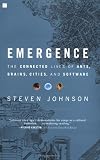
Last week I was reading the final leg of Steven Johnson's Emergence--the by now slightly dated 2001 overview of self-organizing systems, emergent phenomena, and consciousness. I started it several weeks ago, but non-fiction books always take me longer to read. Partially because I can't get lost in their world, partially because I keep needing to stop to think.

One thing that kept making me pause was the thought--how do these ideas apply to art, and to our conception of the artist?
On the one hand, the idea of creating something emergent, something that is unpredictable, out of one's control, open ended, endlessly developing--seems like the ultimate art: to birth something that truly stands on its own, unlimited by one's own limitations.
Yet I remember that the year I finished high-school I got involved in designing an computer adventure game with some friends. It was just when the filmed games like my well-love Gabriel Knight were going out, and the 3-D craze was beginning to hit. At first we were entranced by the endless possibilities, but then got frustrated when the game began to be about the technology. We couldn't create a coherent plot, or characters, if the world could take off on its own. We wanted to be the gods of our little world, the stage-managers, not the observing scientist.
In his classical work the Mirror and the Lamp, Abrams outlines two primary views of art and the artist. The first is the Classical: Art is mimesis, and the artist is a mirror, reflecting the outer world in a new form. Then comes the great Romantic revolution, which conceived art as creation-ex-nilo: the artist as a God-like being, who creates art out of his own being, a self-sustaining lamp rather than a passive mirror.
We would need another revolution for an Emeregence-like art: a turn towards a more Darwinian view of art as an emergent process, or as observation, or as setting a system into place. Though we still live in a largely Romantic milieu, with an obsession with genius and individuality, and the persona of the Artist, it is beginning to happening. There is process art, and instillations that are formed through the participation of the viewers. Not to mention the Robert Wilson's early work, with its semi-improvisations. Yet these do seem closer to Intelligent Design, with a great Artist setting the parameters, and marking the final results.

And another part of me, that finds much of the new art lacking (though not Robert Wilson!) protest that all great art has an element of emergence. Even in my earliest work, I would not consider a painting done until it began to express more than what I had put into it, until it became more than what I was looking at, and more than the paint and canvas of which it was made. One of my teachers, Jordan Wolfson called it "having a face": the painting looks back at you. I still remember my shock at seeing Caravaggio's Flagellation close up, the big toe near my eye, and thinking this is paint. A splatter of red, the mark of the brush. And yet the next moment, it was not paint again: it was light, and it was beauty, and it was heartbreaking vulnerability. Or Titian's Ascension of the Virgin which literally left me breathless, able to do nothing but stare. A glowing point ahead of you, as you walk down the dark aisle of Santa Maria Gloriosa dei Frari, seemingly lit by its own light, even as the light of two windows hits it. There is the emergence that comes of the transformation of matter, when material becomes something else through what is invested in it.
The Zohar writes "when all the artist came to finish their work, the work finished itself."

Is there a relation between these two kinds of emergence? Is there still room for the latter in a world that is more and more defined by the former? How do you connect the two? Can they be connected? Making material breath, "have a face", seems to require a deeper investment than setting a process in motion and watching where it goes--or endless time, for the profoundly slow work of evolution to take place.


Wednesday, March 2, 2011

The Possessed

A rather dramatic heading, but I sometimes feel like that lately...

There comes a time when mental confusion spreads to the body, and you end up literally at war with yourself. My last two weeks of a hellish ear-infection combined with a come-and-go stomach virus are a perfect example.

But I actually was referring to Elif Batuman's The Possessed, which was recently given to me by a friend as a "must-read for any literature graduate student"--which it is.

I'm not even half way through, but wanted to post a few quick thoughts, just to make myself feel connected again (oh for the the number of thoughts that have slipped through my brain in the past chaotic weeks...). Somehow books often act as the easiest touchstone for writing. Maybe its the academic training.

First, the fascination of the writing style. A montage of vignettes from college life (though I must say, she gets to do far more interesting things than I I ever did as a graduate student), those strangely juxtaposed events that can only be reality. We all have them, but we usually let them remain fragmented and half forgotten in the back of our mind. But somehow Batuman strings them together in a way that the whole becomes more then the sum of its parts. You begin to get intimations of wholeness, of meaning, behind the chaos.

In visual terms, this would be a kind of collage of sketches that somehow interact together to form a coherent whole.

And, just wanted to share a quote that really spoke to me. In regards to her doubts about the value of studying Russian literature, Batuman writes "I now understand that love is a rare and valuable thing, and you don't get to choose its object. You just go around getting hung up on all the least convenient things--and if the only obstacle in your way is a little extra work, then that's the wonderful gift right there" (88-89). I think there is a profound truth there. We get so caught up in the questions of what's right, or what's meaningful. Is painting yet another small still-life of a pear, or an onion, really worth anything? But there is also the fact of love. The things that draw on us enough to connect. And sometimes we have to take the time to pause, breath, and stop ourselves from undermining this more "rare and valuable thing".

Reading this passage this morning, I suddenly vividly remembered a poem I had almost forgotten: PatrickKavanagh's "Innocence"

They laughed at one I loved-

The triangular hill that hung

Under the Big Forth. They said

That I was bounded by the whitethorn hedges

Of the little farm and did not know the world.

But I knew that love's doorway to life

Is the same doorway everywhere.

Ashamed of what I loved

I flung her from me and called her a ditch

Although she was smiling at me with violets.

But now I am back in her briary arms

The dew of an Indian Summer lies

On bleached potato-stalks

What age am I?

I do not know what age I am,

I am no mortal age;

I know nothing of women,

Nothing of cities,

I cannot die

Unless I walk outside these whitethorn hedges

A different time, a different ambiance, a different literature, but I was happy to remember it...


Monday, February 14, 2011

A few more images from Tel Aviv

I never can resist spirals:


And have a deep fashination with the hetrotopias of reflections:

Posted by Picasa