I never can resist spirals:

And have a deep fashination with the hetrotopias of reflections:


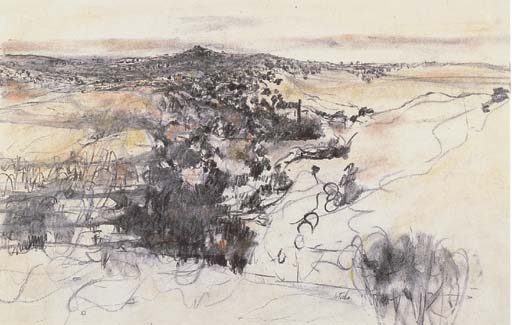
Once I was at the Anna Ticho House, I nipped upstairs for a quick visit to the regular exhibition space. After a day of looking at the photography and prints section of the Jerusalem Drawing Biennale, Anna Ticho's familiar drawings struck me anew. There is something incredibly moving about the sense of infinite patience in her large charcoal drawings. You feel that she would be happy to rest forever on each blade of grass. There is no hurry to get done, no worry about a final product: it is all in the process, in the loving contact of mark with landscape.
I was reminded of my thoughts at the Sotheby’s auction of Israeli art last year. For me, Ticho's work embodies within it the innocence and idealism of early Zionism--the dream of regeneration through contact with the soil, the melding of soul with land. Something in the complete unison of philosophical commitment with material expression makes these relatively unsophisticated drawings more complete works of art than most the sleek modern works of the biennale.


"I thought I ought to make up for the 'glory of the mind' side with a second journal that would talk about the body[...] Not the profound thoughts of the mind, but the masterpieces of matter. Something incarnate, tangible. But beautiful and aesthetic at the same time" (p.33. Page numbers are from the GallicThis can almost serve as the by-line for this blog--it was the central idea that drove me to start writing it: to note down both the thoughts, and the passing stimulus and phenomena that feed art. Alas that I have not been as consistent as Paloma in keeping with my plan of Journals of Profound Thoughts and Journals of the Movement of the World.
edition)
""Humans live in a world where it's words and not deed that have power, where the ultimate skill is mastery of language. This is a terrible thing because basically we are primates who've been programmed to eat, sleep, reproduce, conquer and make our territory safe, and the ones who are most gifted at that, the most animal types among us, always get shafted by others, the fine talkers, despite the latter being incapable of defending their own garden or bringing a rabbit home for dinner, or procreating properly. Humans live in a world with the weak are dominant. This is a terrible insult to our animal nature, a sort of perversion or a deep contradiction." (53)
"At moments like this the web of life is revealed by the power of ritual, and each time we renew our ceremony, the pleasure will be all the greater four our having violated one of its principle. Moments like this act as magical interludes, placing our hears at the edge of our souls: fleetingly, yet intensely, a fragment of eternity has come to enrich time. Elsewhere the world may be blustering or sleeping, wars are fought, people love and die, some nations disintegrate, while others are born, soon to be swallowed up in turn--and in all this sound and fury, amidst eruptions and untertows, while the world goes its merry way, bursts into flame, and tears itself apart and is reborn: human life continues to throb.
...The tea ritual: such a precise repetition of the same gestures and the same tastes ...has the extraordinary virtue of introducing into the absurdity of our lives an aperture of serene harmony. Yes, the world may aspire to vacuousness, lost souls mourn beauty, insignificance surrounds us. Then let us drink a cup of tea. Silence descends, one hears the wind outside, the autumn leaves rustle and take flight, the cat sleeps in a warm pool of light. And with each swallow, time is sublimed." (P. 87)On still-life painting (the whole of chapters 10-11 are wonderful, but I bring my favorite extracts) :
"Whence comes the sense of wonder we perceive when we encounter certain works of art? Admiration is born with our first gaze and if subsequently we should discover, in the patient obstinacy we apply to flushing out the causes thereof, that all this beauty is the fruit of virtuosity that can only be detected through close scrutiny of a brush that has been able to tame shadow and light and restore shape and texture, by magnifying them--the transparent jewel of the glass, the tumultuous texture of shells, the clear velvet of the lemon--this neither dissipates nor explains the mystery of one's initial dazzled gaze.
The enigma is constantly renewed: great works are the visual forms which attain with us the certainty of timeless consonance....
In the still life with lemons, for example, this essence cannot be reduced to the mastery of execution; it clearly does inspire a feeling of consonance, a felling that this exactly the way it ought to have been arranged. This in turn allows us to feel the power of objects and the way they interact, to hold in our gaze the way they work together and the magnetic fields that attract and repel them, the ineffable ties that bind them together and engender a force, a secret an inexplicable wave born of both the tensions and the balance of the configuration--this is what inspires the feeling of consonance. The disposition of the objects and the dishes achieves the universal in the singular: the timeless nature of the constant form. " (197-198)On art in general:
"What is the purpose of Art? To give us the brief, dazzling illusion of the camellia, to carve from time the emotional aperture that cannot be reduced to animal logic. How is Art born? It is begotten in the mind's ability to sculpt the sensorial domain. What does Art do for us? It gives shape to our emotions, makes them visible, and in so doing, places a seal of eternity upon them, a seal representing all those works that, by means of a particular form, have incarnated the universal nature of human emotions." (199)
"Beauty consist of its own passing, just as we reach for it. It's the ephemeral configuration of things in the moment, when you can see both their beauty and their death...Constantly posed between beauty and death, movement and its disappearance. " (272-3)And on life in general--echoes of Ecclesiastes here:
"Personally, I think there is only one thing to do: find the task we have been placed on this earth to do, and accomplish it as best we can, with all our strength, without making things complicated or thinking there is anything divine about our human nature. This is the only way we will ever feel that we have been doing something constructive when death comes to get us. Freedom, choice, will and so on? Chimeras. We think we can make honey without sharing in the fate of the bees, but we are in truth nothing but poor bees, destined to accomplish our tasks and then die." (238)And the closing of the book:
"It's as if those strains of music created a sort of interlude in time, something suspended, an elsewhere that had come to us, and always within never.Yes, that's it, an always within never."