Last week I was reading the final leg of Steven Johnson's Emergence --the by now slightly dated 2001 overview of self-organizing systems, emergent phenomena, and consciousness. I started it several weeks ago, but non-fiction books always take me longer to read. Partially because I can't get lost in their world, partially because I keep needing to stop to think.
--the by now slightly dated 2001 overview of self-organizing systems, emergent phenomena, and consciousness. I started it several weeks ago, but non-fiction books always take me longer to read. Partially because I can't get lost in their world, partially because I keep needing to stop to think. 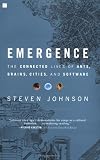
One thing that kept making me pause was the thought--how do these ideas apply to art, and to our conception of the artist?
On the one hand, the idea of creating something emergent, something that is unpredictable, out of one's control, open ended, endlessly developing--seems like the ultimate art: to birth something that truly stands on its own, unlimited by one's own limitations.
Yet I remember that the year I finished high-school I got involved in designing an computer adventure game with some friends. It was just when the filmed games like my well-love Gabriel Knight were going out, and the 3-D craze was beginning to hit. At first we were entranced by the endless possibilities, but then got frustrated when the game began to be about the technology. We couldn't create a coherent plot, or characters, if the world could take off on its own. We wanted to be the gods of our little world, the stage-managers, not the observing scientist.
In his classical work the Mirror and the Lamp, Abrams outlines two primary views of art and the artist. The first is the Classical: Art is mimesis, and the artist is a mirror, reflecting the outer world in a new form. Then comes the great Romantic revolution, which conceived art as creation-ex-nilo: the artist as a God-like being, who creates art out of his own being, a self-sustaining lamp rather than a passive mirror.
, Abrams outlines two primary views of art and the artist. The first is the Classical: Art is mimesis, and the artist is a mirror, reflecting the outer world in a new form. Then comes the great Romantic revolution, which conceived art as creation-ex-nilo: the artist as a God-like being, who creates art out of his own being, a self-sustaining lamp rather than a passive mirror.We would need another revolution for an Emeregence-like art: a turn towards a more Darwinian view of art as an emergent process, or as observation, or as setting a system into place. Though we still live in a largely Romantic milieu, with an obsession with genius and individuality, and the persona of the Artist, it is beginning to happening. There is process art, and instillations that are formed through the participation of the viewers. Not to mention the Robert Wilson's early work, with its semi-improvisations. Yet these do seem closer to Intelligent Design, with a great Artist setting the parameters, and marking the final results.
And another part of me, that finds much of the new art lacking (though not Robert Wilson!) protest that all great art has an element of emergence. Even in my earliest work, I would not consider a painting done until it began to express more than what I had put into it, until it became more than what I was looking at, and more than the paint and canvas of which it was made. One of my teachers, Jordan Wolfson called it "having a face": the painting looks back at you. I still remember my shock at seeing Caravaggio's Flagellation close up, the big toe near my eye, and thinking this is paint. A splatter of red, the mark of the brush. And yet the next moment, it was not paint again: it was light, and it was beauty, and it was heartbreaking vulnerability. Or Titian's Ascension of the Virgin which literally left me breathless, able to do nothing but stare. A glowing point ahead of you, as you walk down the dark aisle of Santa Maria Gloriosa dei Frari, seemingly lit by its own light, even as the light of two windows hits it. There is the emergence that comes of the transformation of matter, when material becomes something else through what is invested in it.
The Zohar writes "when all the artist came to finish their work, the work finished itself."
Is there a relation between these two kinds of emergence? Is there still room for the latter in a world that is more and more defined by the former? How do you connect the two? Can they be connected? Making material breath, "have a face", seems to require a deeper investment than setting a process in motion and watching where it goes--or endless time, for the profoundly slow work of evolution to take place.


so that's two books of separation since last we met. I picked up Emergence in 2004 back from Israel, under the influence of your father's "Framework's" piece on the reductionism and the Mishkan, among other things - "The Possessed" I pick up about once a month from the shelf of the university library where I work in fulfillment of a given patron request. though now also dated, I recommend "Ambient Findability", for related, emergent reasons.
ReplyDeleteAh, the links formed through books.... Been thinking a lot about that essay actually.
ReplyDelete